
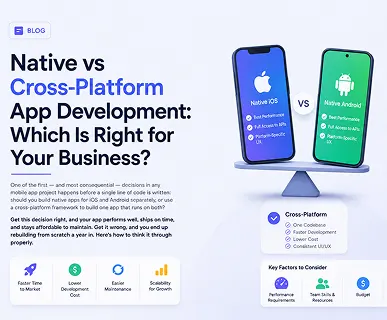
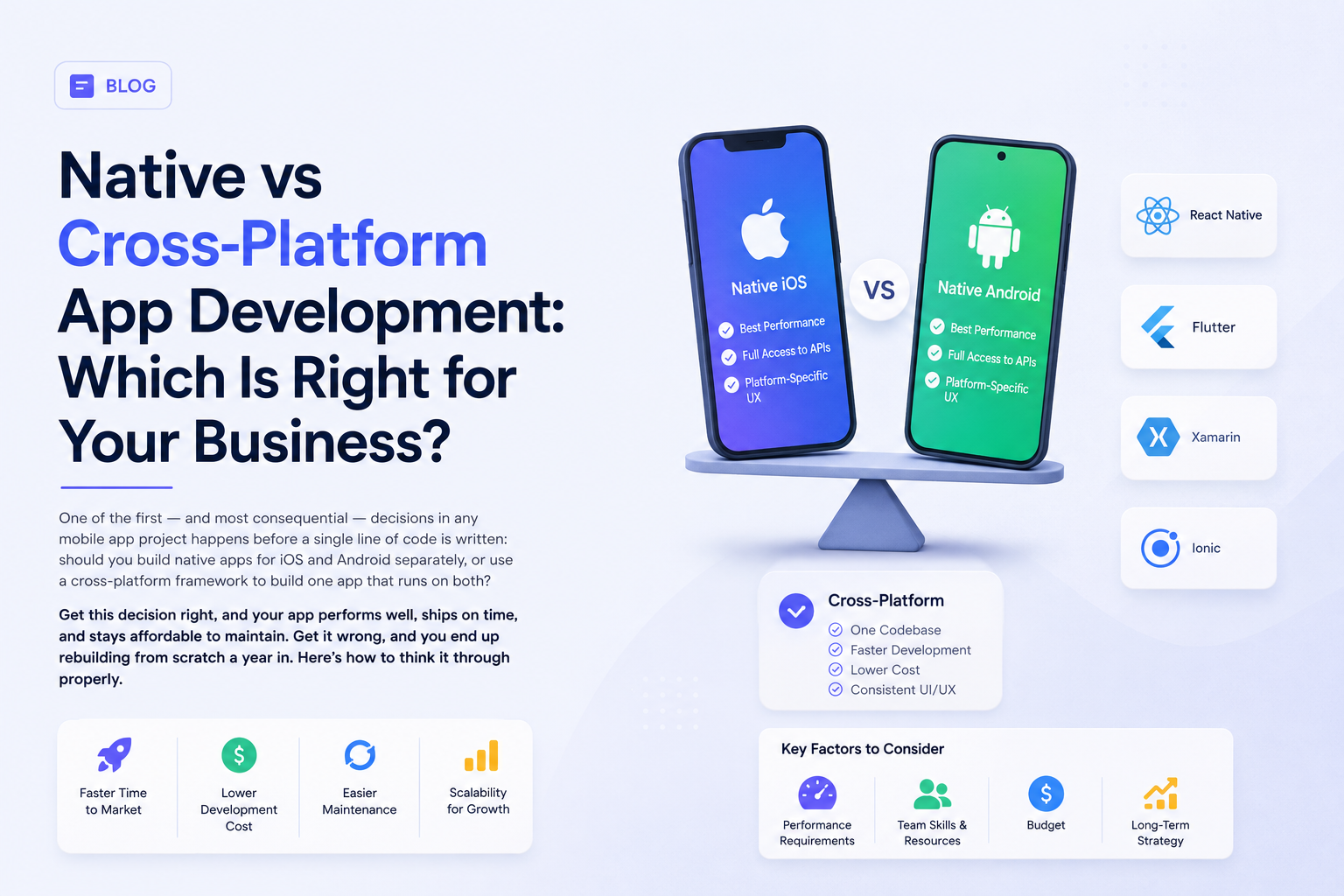
One of the first — and most consequential — decisions in any mobile app project happens before a single line of code is written: should you build native apps for iOS and Android separately, or use a cross-platform framework to build one app that runs on both?
Get this decision right, and your app performs well, ships on time, and stays affordable to maintain. Get it wrong, and you end up rebuilding from scratch a year in. Here’s how to think it through properly.
What Is Native App Development?
Native development means building a separate app for each platform, using each platform’s own language and tools — Swift or Objective-C for iOS, Kotlin or Java for Android. Each app is written specifically for its operating system, giving it direct access to all device features and the best possible performance.
Pros:
- Best possible performance, especially for graphics-heavy or hardware-intensive apps (gaming, AR/VR, camera-based apps)
- Full, immediate access to the latest OS features
- Generally smoother, more “native-feeling” user experience
Cons:
- Two separate codebases means roughly double the development time and cost
- Updates and bug fixes must be built and tested twice
- Requires developers skilled in two different tech stacks
What Is Cross-Platform App Development?
Cross-platform development uses a single codebase — written in a framework like Flutter or React Native — that compiles into apps for both iOS and Android. Instead of maintaining two separate projects, your team builds and maintains one.
Pros:
- Faster development timeline and lower cost, since you’re building once, not twice
- Easier long-term maintenance — one codebase for bug fixes and new features
- Modern frameworks like Flutter now achieve near-native performance for most business apps
Cons:
- Extremely graphics-intensive or hardware-specific apps may still need native components
- Occasionally lags slightly behind in adopting brand-new OS features on day one
Which Should You Choose?
Choose native if:
- Your app is heavily reliant on device hardware (advanced camera features, AR/VR, complex animations, gaming)
- Performance is the single most important factor and budget is not a primary constraint
- You need day-one access to the newest OS-specific features
Choose cross-platform if:
- You’re a startup or SME needing to launch on a budget and timeline
- Your app is a fairly standard business app (e-commerce, booking, content, service-based)
- You want to reach both iOS and Android users without doubling your development investment
In our experience building apps across both approaches, the majority of business apps — e-commerce, service booking, internal operations tools, content platforms — are excellent candidates for cross-platform development. The performance gap has narrowed significantly, and the cost/time savings are hard to ignore.
Cost and Timeline Comparison (General Guidance)
| Factor | Native (iOS + Android) | Cross-Platform |
|---|---|---|
| Development cost | Higher (two builds) | Lower (one build) |
| Timeline | Longer | Shorter |
| Maintenance | Two codebases to update | One codebase to update |
| Performance ceiling | Highest | Very high, near-native |
(Exact costs depend heavily on feature complexity — these are directional, not fixed quotes.)
A Third Option: Hybrid Approach
Some businesses start with cross-platform for speed to market, then move performance-critical modules to native components later as the app scales. This “best of both worlds” strategy works well for apps expected to grow significantly in complexity over time.
Frequently Asked Questions
Is Flutter as good as native development? For the vast majority of business apps, yes — Flutter apps can achieve performance very close to native, while cutting development time and cost significantly.
Can I switch from cross-platform to native later? Yes, though it typically means a partial or full rebuild. Many businesses instead choose a hybrid approach, moving only specific performance-critical features to native as needed.
Which is better for an MVP (minimum viable product)? Cross-platform is almost always the better choice for an MVP — it lets you validate your idea on both platforms faster and cheaper before committing to a bigger native build.
Do cross-platform apps work well for e-commerce and booking apps? Yes, extremely well. These app types rarely need the hardware-intensive features that would push you toward native development.