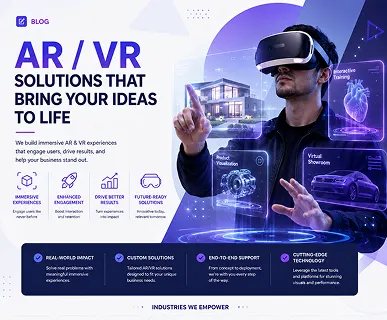
Augmented Reality (AR) and Virtual Reality (VR) spent years being associated mostly with gaming. That’s changed. Businesses across retail, real estate, healthcare, education, and events are now using AR/VR to solve real, practical problems — letting customers experience a product or space before committing, training staff without real-world risk, and standing out in markets where every competitor still looks the same online.
AR vs VR: A Quick Clarification
Augmented Reality (AR) overlays digital content onto the real world through a phone, tablet, or AR glasses — think a furniture app showing how a sofa looks in your actual living room.
Virtual Reality (VR) replaces the real world entirely with a fully digital environment, typically experienced through a headset — think a fully immersive virtual property tour or training simulation.
Both fall under the broader “immersive technology” umbrella, and increasingly, businesses combine elements of both depending on the use case.
Real Business Use Cases
Retail & E-commerce: Virtual try-on for clothing, makeup, and eyewear; AR furniture placement tools that show products in a customer’s actual space before purchase — directly reducing return rates caused by mismatched expectations.
Real Estate: Virtual property tours let prospective buyers or tenants walk through a space remotely, saving time for both agents and clients, and helping properties reach international buyers who can’t visit in person.
Education & Training: VR-based training simulations let employees practice high-risk or high-cost scenarios (equipment operation, safety procedures, medical procedures) in a fully safe, repeatable virtual environment.
Events & Marketing: AR-powered interactive booths, filters, and branded experiences create memorable, shareable moments at trade shows and product launches — turning a static booth into an experience worth talking about.
Healthcare: VR is increasingly used for pain management, physical therapy exercises, and surgical training simulations that let practitioners rehearse before operating on a real patient.
Hospitality & Tourism: Virtual hotel or destination tours help travelers make booking decisions with more confidence, reducing cancellations driven by mismatched expectations.
Why Businesses Are Investing in AR/VR Now
1. Hardware is more accessible. AR no longer requires special hardware — it runs directly through smartphone cameras. VR headsets have also dropped significantly in price and improved in comfort and resolution.
2. Customers expect richer digital experiences. As e-commerce and digital-first business models mature, static photos and text descriptions are no longer enough to differentiate — immersive experiences are becoming a competitive edge, not a novelty.
3. Measurable business impact. Retailers using AR try-on tools consistently report reduced return rates. Real estate firms using virtual tours report faster qualification of serious buyers. The ROI case has moved well past “interesting demo.”
Is AR/VR Right for Your Business?
AR/VR delivers the strongest ROI when:
- Your product benefits from being seen “in context” before purchase (furniture, fashion, real estate, automotive)
- Training involves risk, cost, or logistics that make repeated real-world practice difficult
- You compete in a market where differentiation and memorability matter (events, luxury retail, hospitality)
- Your customers are increasingly research-heavy and expect richer digital previews before committing
It may not be the right first investment if your product is simple, low-consideration, or doesn’t benefit from spatial/visual context — in those cases, other digital investments (like conversion-focused UI/UX or app development) may deliver faster returns.
Getting Started With AR/VR
- Start with a single, well-defined use case — a virtual try-on for one product line, or a training module for one process — rather than attempting a full AR/VR platform on day one.
- Prioritize accessibility. AR experiences that run through a standard smartphone camera reach far more users than ones requiring dedicated headsets.
- Measure against a clear business metric — return rate reduction, training completion time, lead qualification speed — not just “engagement.”
- Choose a development partner who can scope realistically — AR/VR project timelines and costs vary enormously depending on complexity, and vague scoping is the most common cause of budget overruns in this space.
Frequently Asked Questions
Do customers need special equipment to use AR features? Not necessarily — most modern AR experiences run directly through a smartphone camera via a mobile app or web browser, with no headset required. VR experiences do typically require a headset for full immersion.
Is AR/VR only useful for large enterprises? No. Many AR use cases (product visualization, virtual try-on) are increasingly accessible to small and mid-sized businesses, especially retailers and real estate firms.
How long does it take to build an AR/VR feature? This varies enormously based on complexity — a simple AR product viewer takes far less time than a fully interactive VR training simulation. Scoping a clear use case upfront is the best way to get an accurate timeline.
What industries benefit most from AR/VR right now? Retail, real estate, education/training, and events are currently seeing the strongest, most measurable ROI from AR/VR adoption.